01
Act I
The town, the tax, and the first rebellion
Cipollino · Act IPlayback is hosted by YouTube.
Open on YouTube ↗Full ballet 03 · Family story ballet in two acts
A colorful town discovers that friendship can be stronger than fear when a brave Little Onion and his friend Radish stand up to Prince Lemon.
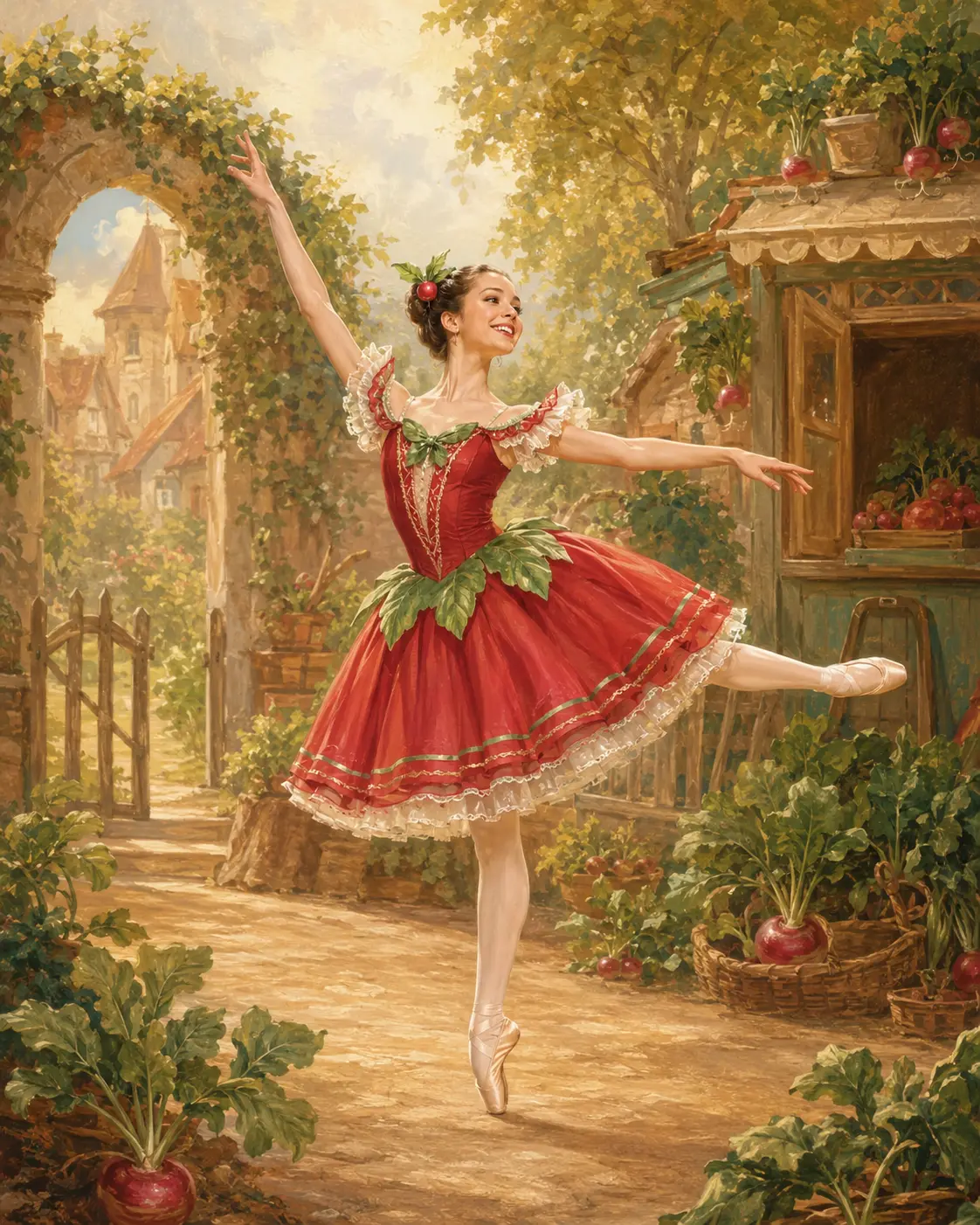
Radish · Act I
Watch from curtain to curtain
Watch first for the story, then return to study how the dancers make each fruit-and-vegetable character readable through rhythm, gesture, focus, and classical technique.
Act I
Cipollino · Act IPlayback is hosted by YouTube.
Open on YouTube ↗Act II
Cipollino · Act IIPlayback is hosted by YouTube.
Open on YouTube ↗The complete story
This page follows the supplied two-act production. Some companies divide the same story into three acts, but the central journey and characters remain the same.
Act I
In a lively fairy-tale town, vegetables and fruit live in houses disguised as baskets and market crates. The Onion and Radish families meet in the square while Professor Pear plays, Master Grape works, and old Pumpkin searches for enough bricks to build a tiny home. Cipollino is restless, playful, and already ready to question the rules around him.
Signor Tomato announces Prince Lemon’s new law: the townspeople must pay for sunshine, rain, and wind. During the uproar, Cipollino steps on the Prince’s foot and his father, Cipollone, is arrested in his place. When the guards later destroy Pumpkin’s newly built house because it stands on the Countesses Cherries’ land, Cipollino resolves to fight the injustice.
Act II
Cipollino and Radish go to the palace to find the prison where Cipollone is held. They meet the lonely young Count Cherry, who chooses friendship over privilege and helps them move through the palace. During a ball for Prince Lemon, the friends free Cipollone and escape the guards.
Cipollino is eventually captured, but Count Cherry and Magnolia outwit the guards and release him. Prince Lemon orders the town attacked with a cannon; the townspeople turn the threat back on their ruler and send him away. The old order disappears, and the community celebrates a new Town of Friends built on courage, cooperation, and freedom.
Meet the characters
The costumes are fantastical, but the relationships are clear: friends protect one another, power isolates, and courage spreads through a community.
The Little Onion
Playful, brave, and quick to defend others. His courage grows from mischief into leadership as the town unites around him.
His loyal friend
Bright, energetic, and generous. She joins Cipollino’s search, carries the story’s spirit of friendship, and dances the catalog’s Radish Variation.
The ruler
Vain and absurdly authoritarian. His laws turn ordinary gifts of nature into taxes and make his comic grandeur dangerous to the town.
The enforcer
The Prince’s officious agent, quick to defend property and punish resistance. His sharp theatricality contrasts with the warmth of the townspeople.
Cipollino’s father
A loving father who protects his son and is imprisoned in his place. His rescue gives Cipollino’s rebellion a deeply personal purpose.
The palace ally
A lonely young aristocrat who chooses friendship and justice. He helps Cipollino and Radish navigate the palace and free the prisoners.
For variation students
The Radish Variation is most convincing when quick footwork and bright musical accents grow from her personality. Study the whole ballet to see how warmth, alertness, and courage shape the choreography beyond the competition excerpt.
Find the Radish VariationNotice how she belongs to the ensemble before she becomes a soloist: focus and reaction establish friendship first.
Small jumps and quick feet should feel like bright speech, not disconnected technical display.
Make changes of direction, eye line, and port de bras legible without exaggerating them into pantomime.
Radish is playful, but never passive. Let the final pose show the friend who will follow Cipollino into the palace.
Behind the ballet
Karen Khachaturian composed Cipollinoto a libretto by Gennady Rykhlov, adapted by choreographer Genrikh Maiorov from Gianni Rodari's story The Adventures of Cipollino. The ballet received its world premiere in Kyiv in 1974.
Its vivid characters and comic storytelling make it welcoming for young audiences, while its variations, ensembles, and partnering remain firmly rooted in classical ballet. Stagings may use two or three acts, and the names Maiorov, Mayorov, Cipollino, and Chipollino reflect different transliterations.