Variation marker · Act I
Swanhilda’s Entrance Variation
Swanhilda enters the village square and tries to attract the silent girl at the window. Times are specific to the supplied production.
- Start
- 4:35
- End
- 6:54
- Duration
- 2:19
Full ballet 01 · Comic ballet in three acts
A sunlit comedy about love, jealousy, and a mechanical girl who seems almost human—until Swanhilda steps behind the curtain.
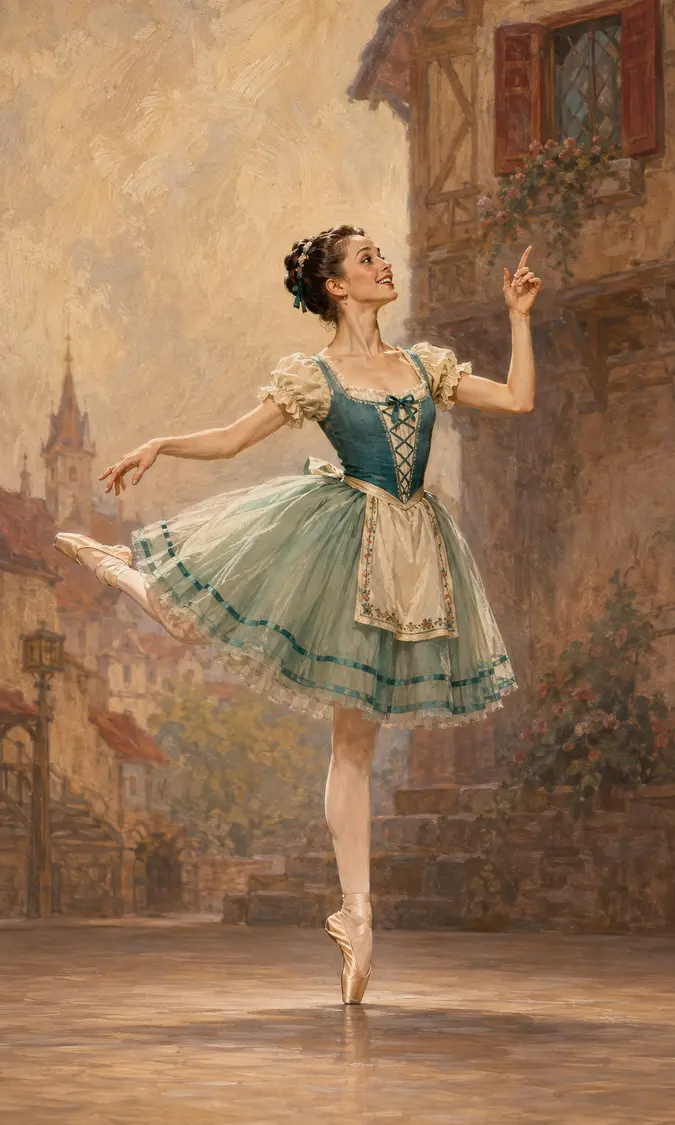
Swanhilda · Act I
Watch from curtain to curtain
Watch once for the plot, then return to study entrances, character choices, musical themes, and how each solo grows out of the scene around it.
Full ballet · supplied productionPlayback is hosted by YouTube.
Open on YouTube ↗Variation marker · Act I
Swanhilda enters the village square and tries to attract the silent girl at the window. Times are specific to the supplied production.
Variation marker · Act II
The mechanical-doll episode inside Dr. Coppélius’s workshop. Times are specific to the supplied production.
Variation marker · Act II
Swanhilda, disguised as the doll, performs the Spanish boléro for Coppélius. Times are specific to the supplied production.
Variation marker · Act III
Dawn appears during the allegorical Festival of the Bell divertissement. Times are specific to the supplied production.
Variation marker · Act III
Prayer follows Dawn with a sustained, devotional adagio. Times are specific to the supplied production.
Variation marker · Act III
Work is represented by the harvest ensemble with scythes. Times are specific to the supplied production.
Variation marker · Act III
The playful Folly solo completes the group of featured allegorical variations. Times are specific to the supplied production.
Variation marker · Act III
This production performs the edition catalogued in the Finder as Franz’s Second Variation. Times are specific to the supplied production.
Variation marker · Act III
Swanhilda’s radiant bridal solo leads toward the final celebration. Times are specific to the supplied production.
The complete story
Productions differ in small details, but the central journey remains the same: a village misunderstanding leads into a workshop of illusions and ends at a wedding.
Act I
In a lively village square, Swanhilda is preparing to marry Franz. Their happiness is disturbed when Franz becomes fascinated by a beautiful, silent girl who sits reading on Dr. Coppélius’s balcony. Swanhilda waves and bows, but the stranger never answers. Jealous of Franz’s attention and curious about the mysterious girl, Swanhilda tests whether Franz truly loves her and quarrels with him when his interest becomes impossible to ignore.
When the eccentric Dr. Coppélius leaves and drops his key, Swanhilda and her friends slip into his workshop. Franz has his own plan: after nightfall, he climbs toward the balcony to meet the girl he believes is Coppélius’s daughter.
Act II
The workshop is filled with extraordinary mechanical dolls. Swanhilda soon discovers that the silent beauty is not a rival at all—Coppélia is the toy-maker’s most lifelike creation. When Dr. Coppélius returns, the other girls scatter, but Swanhilda hides behind the doll’s curtain and exchanges places with her.
Coppélius catches Franz, gives him a sleeping potion, and tries to transfer the young man’s life force into Coppélia. Swanhilda pretends that the experiment has worked. She dances first like an awakening doll and then with increasing freedom, delighting and bewildering the old inventor. At last she wakes Franz, reveals the deception, and escapes with him, leaving Coppélius to face his damaged workshop and broken dream.
Act III
The village gathers for Swanhilda and Franz’s wedding. Coppélius arrives furious about the damage to his dolls, but he is compensated and the quarrel is settled. The young couple can finally marry without the illusion that divided them.
A grand festival follows, often including the Dance of the Hours and a sequence of celebratory dances. Swanhilda and Franz join the community in a joyful finale: curiosity has been resolved, jealousy has given way to trust, and human love triumphs over the dream of a perfect mechanical creation.
Meet the characters
Coppélia rewards dancers who understand what each character wants—not only what steps they perform.
The heroine
Bright, observant, and mischievous. Her wit solves the mystery, but her warmth keeps the comedy human.
Her fiancé
A charming young villager whose curiosity about the silent balcony girl sets the story in motion. The name is also spelled Frantz in some productions.
The inventor
An eccentric toy-maker who longs to bring his greatest doll to life. Comic and touching, he is more than a simple villain.
The mechanical doll
The apparently perfect girl at the window. She never acts on her own; everyone else reveals themselves through what they imagine her to be.
For variation students
Technique becomes more specific when the dancer knows the dramatic moment. Study the full production before deciding how Swanhilda looks, reacts, and speaks through movement—or how Franz carries the joy of the final celebration.
Find the Coppélia variationsNotice what she already knows about Franz and why the silent girl immediately matters.
Track who she is addressing, where her focus travels, and how the waltz supports her curiosity.
Compare human warmth with mechanical precision. Swanhilda’s imitation works because both qualities remain legible.
Watch how Franz’s open épaulement, ballon, and generosity belong to a public celebration rather than an isolated display.
Behind the ballet
Coppélia premiered in Paris in 1870, with a score by Léo Delibes and an original scenario and choreography associated with Charles Nuitter and Arthur Saint-Léon. Its inspiration came from E.T.A. Hoffmann's uncanny story The Sandman, but the ballet reshaped the material into a humane comic world led by Swanhilda's intelligence.
Later productions have inherited and revised choreography through artists such as Marius Petipa, Enrico Cecchetti, Lev Ivanov, and Ninette de Valois. Steps, staging, names, and plot details can therefore vary—one reason it is useful to identify the edition a dancer is studying.