BBallet Variation Studio
← Full ballet library

Full ballet 04 · Ballet-féerie in one act, two scenes

The Fairy Doll

A jewel-box fantasy in which a treasured doll awakens an entire toy shop for a secret celebration after midnight.

Music
Josef Bayer
Russian additions
Riccardo Drigo
Choreographic lineage
Hassreiter / Legat brothers
Premiere
Vienna · 1888
Explore the variations
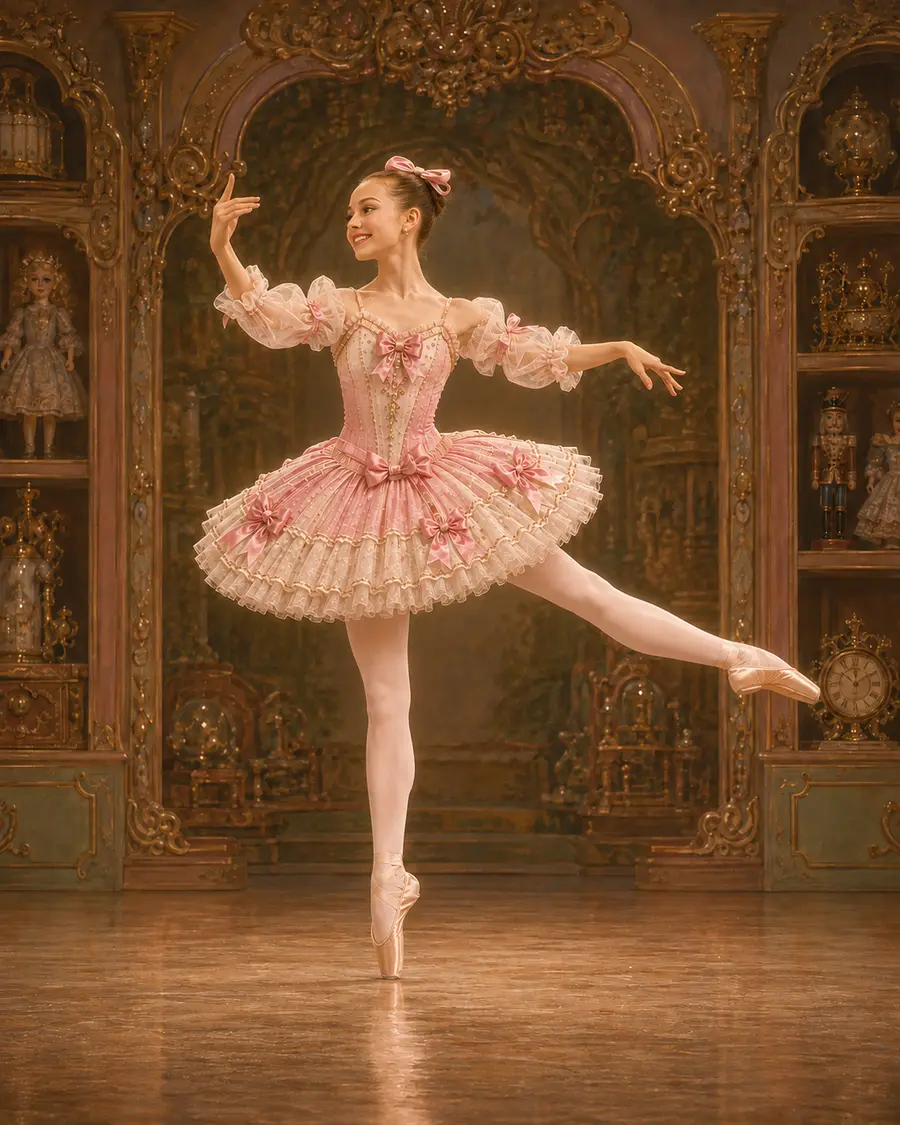
Illustration of the Fairy Doll dancing inside an enchanted antique toy shop

The Fairy Doll · Pas de trois

Watch from curtain to curtain

See the doll become the heart of the story.

Watch first for the playful toy-shop narrative, then return to compare each doll’s movement quality and see how the Fairy Doll’s polished classical style sets her apart from the surrounding character dances.

Vaganova Ballet Academy recording1:06:59 · playback is hosted by YouTube.

Open on YouTube ↗

The complete story

One day, one midnight, two worlds.

The ballet is structured as a divertissement: the simple story creates a frame for many contrasting dolls, while the Fairy Doll connects the daytime display to the magical celebration after dark.

01

Scene I

The toy shop by day

Inside a fashionable toy shop, the owner and his assistants prepare an extraordinary collection of mechanical dolls. Customers arrive throughout the day, and the dolls are demonstrated one by one: each awakens just long enough to reveal a distinctive dance, costume, and personality before returning to stillness.

A wealthy English family comes searching for a remarkable purchase. The shopkeeper saves his greatest treasure for last—the Fairy Doll. Her elegant waltz captivates the visitors, and they agree to buy her. The family departs while the shop closes for the night, leaving its silent inhabitants behind.

02

Scene II

Midnight in the shop

When the clock strikes midnight, the Fairy Doll reveals her magic. She brings the other toys to life, and the orderly showroom becomes a secret world of dancing dolls. Pierrots, character dolls, soldiers, and toys from across the collection join a brilliant celebration with the Fairy Doll at its center.

The shopkeeper and his assistant return after hearing a disturbance, but the dolls freeze before they can be discovered. When the humans leave, the celebration begins again. As dawn approaches, the Fairy Doll sends every toy back to its place, preserving the enchantment until the shop closes once more.
Meet the characters

A whole world waiting on the shelves.

Every doll needs a sharply defined movement language. The Fairy Doll leads through refinement and warmth rather than behaving like an ordinary human heroine.

01

The enchanted queen

The Fairy Doll

The shop’s most beautiful and coveted creation. By day she performs for customers; at midnight she becomes the gracious leader who gives the other dolls life.

02

Keeper of the shop

The Toymaker

A proud showman as well as a craftsman. He presents each doll to the visitors but never fully sees the magical life hidden inside his collection.

03

The Fairy Doll’s partners

The Pierrots

Two theatrical doll figures who frame the Fairy Doll in the Russian pas de trois. Their buoyancy and wit sharpen her polished, delicate quality.

04

The enchanted ensemble

The Dolls

Baby, Tyrolean, Spanish, Chinese, Japanese, Harlequin, soldier, drummer, and other dolls transform the shop into a parade of contrasting rhythms and characters.

Competition variations

More than one doll can step into the spotlight.

The Fairy Doll is the best-known solo from this ballet, but competition dancers also perform character variations drawn from the toy-shop world. Drummer Bunny emphasizes playful rhythmic precision, Spanish Doll brings fiery theatrical musicality, and Chinese Doll focuses on compact precision, delicate character detail, and poised control.

Open the Variation Finder
  1. 01

    Fairy Doll

    Fairy Doll Variation · Legat pas de trois

    The familiar competition solo emphasizes poised balances, delicate articulation, controlled changes of direction, and the contrast between mechanical stillness and lyrical movement.

    Intermediate · Delicate · animated · jewel-box precise

    Balances · quick footwork · character acting

  2. 02

    Drummer Bunny

    Also known as Fairy Doll Drumming Variation

    A characterful doll solo that combines quick articulated footwork, buoyant petit allegro, crisp rhythmic accents, and toy-like acting. The challenge is to stay playful without sacrificing classical neatness.

    Intermediate · rare · Playful · rhythmic · mechanical · bright

    Quick footwork · petit allegro · balances · character acting

  3. 03

    Spanish Doll

    Spanish Doll Variation · character doll solo

    A vivid character variation shaped by crisp Spanish accents, quick articulated footwork, poised balances, and theatrical musicality. The challenge is to keep the character strong without disturbing classical alignment.

    Intermediate · rare · Fiery · proud · rhythmic · theatrical

    Quick footwork · balances · character acting

  4. 04

    Chinese Doll

    Chinese Doll Variation · character doll solo

    A crisp character variation built around neat articulated footwork, poised balances, compact musical accents, and controlled doll-like presentation. The challenge is to keep every decorative detail coordinated with clean classical placement.

    Intermediate · rare · Precise · delicate · bright · composed

    Quick footwork · balances · character acting

For variation students

Dance the Fairy Doll as the queen of her world.

The familiar competition solo belongs to the Russian pas de trois for the Fairy Doll and two Pierrots. Watching the full ballet makes the character’s delicate precision, sustained poses, and gracious authority much clearer.

Find the Fairy Doll Variation
  1. 01

    Study the daytime display

    Notice how the Fairy Doll acknowledges an audience while preserving the controlled polish of a treasured mechanical creation.

  2. 02

    Contrast stillness and life

    Held poses should look intentionally placed, then soften into flowing transitions as the doll’s magic becomes visible.

  3. 03

    Relate to the Pierrots

    The solo is part of a pas de trois. Let focus and épaulement suggest partners even when the variation is performed alone.

  4. 04

    Lead without heaviness

    The Fairy Doll is the queen of the toys. Show authority through musical timing, calm balance, and clarity—not stiffness or grandeur.

Behind the ballet

A Viennese favorite transformed in Imperial Russia.

Die Puppenfee premiered at the Vienna Court Opera in 1888, with music by Josef Bayer and choreography by Joseph Hassreiter. Its parade of animated toys made the one-act ballet a long-lived family favorite.

Sergei and Nikolai Legat created an important Russian production in 1903. Riccardo Drigo contributed music for a new pas de trois featuring the Fairy Doll and two Pierrots—the choreographic lineage most closely connected to the solo familiar to competition dancers today. Details vary across later reconstructions.

Vaganova Academy repertoire ↗1903 Russian production ↗Ballet synopsis ↗