BBallet Variation Studio
← Full ballet library

Ballet guide 05 · One-act Bournonville ballet

Flower Festival at Genzano

A joyful Italian festival, two young lovers, and one of the most enduring pas de deux in the Bournonville repertory.

Music
Edvard Helsted / Holger Simon Paulli
Choreography
August Bournonville
Premiere
Copenhagen · 1858
Original title
Blomsterfesten i Genzano
Watch the pas de deux
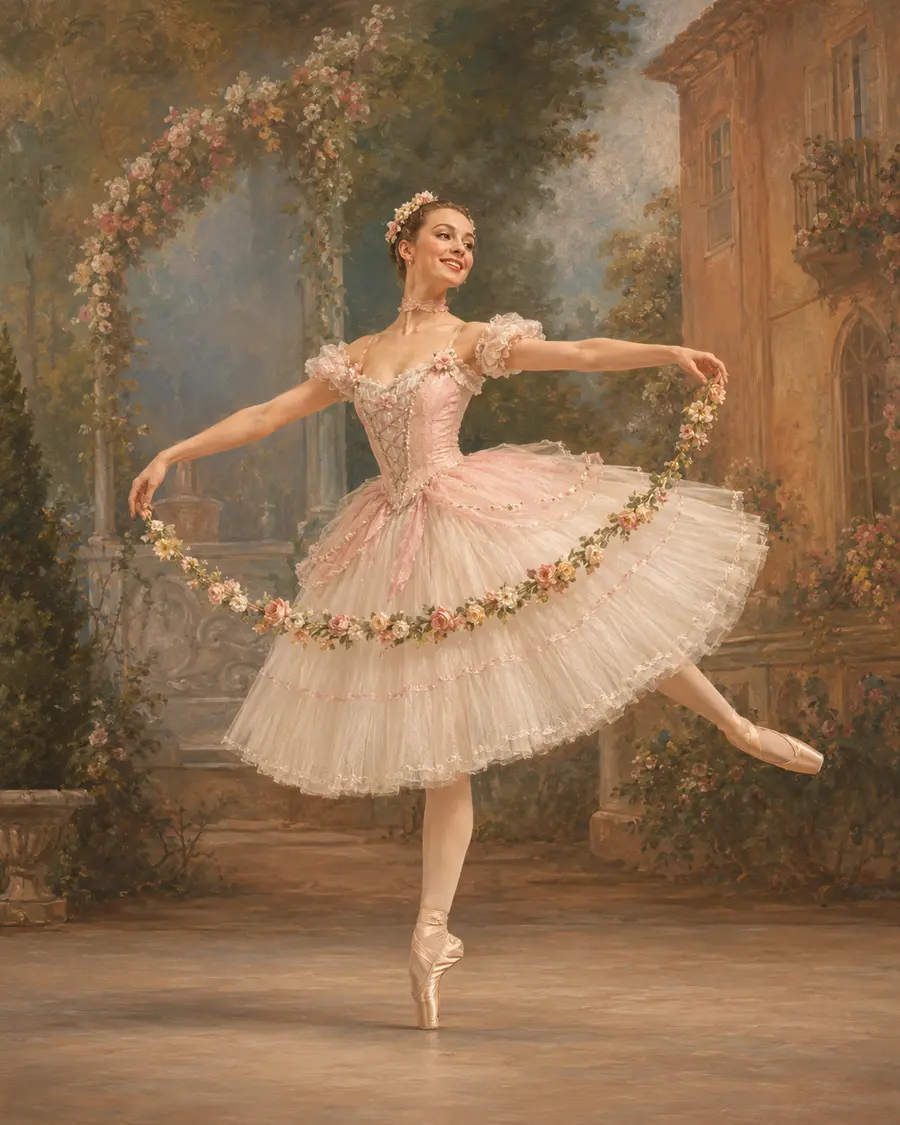
Illustration of the female Flower Festival at Genzano variation in a bright Italian festival setting

Rosa · Flower Festival at Genzano

Pas de deux reference

Study the part of the ballet that survived.

Complete performances of the original one-act ballet are rarely encountered today. This pas de deux is the most important surviving performance reference for understanding Rosa, Paolo, and the competition variations drawn from their dance.

Flower Festival at Genzano · Pas de deuxReference supplied for the ballet guide · playback is hosted by YouTube.

Open on YouTube ↗

The ballet context

A love duet inside a festival world.

The famous pas de deux is not an abstract competition piece. It comes from a one-act ballet set in Genzano, where the atmosphere of an Italian flower festival gives Rosa and Paolo's dancing its warmth, ease, and social character.

01

Story

Rosa and Paolo

The original one-act ballet is set in the Italian town of Genzano and centers on the young lovers Rosa and Paolo. Their relationship belongs to a sunlit festival world rather than the courtly or supernatural settings of many nineteenth-century ballets.

The complete narrative is rarely encountered on stage today, so modern audiences usually meet Rosa and Paolo through the surviving pas de deux rather than through the entire story.

02

Story

The flower festival

The lovers' dance unfolds against the atmosphere of Genzano's flower festival: bright, social, youthful, and celebratory. That setting helps explain why the choreography feels conversational even when the footwork is technically demanding.

In the pas de deux, virtuosity is not presented as a separate display. Jumps, beats, turns, quick footwork, and musical exchanges all serve the sense of two young people dancing together in public celebration.
Meet the characters

The pas de deux is a conversation.

Understanding Rosa and Paolo helps prevent the solos from becoming generic displays of steps. Their dancing should remain youthful, musical, and connected.

01

The young woman

Rosa

The female lead of the surviving pas de deux. Her variation asks for buoyant footwork, gracious épaulement, musical warmth, and effortless-looking classical coordination.

02

The young man

Paolo

Rosa's partner. His dancing combines clean batterie, ballon, quick directional changes, and an easy gallantry characteristic of Bournonville's male style.

03

The social world around them

The festival community

The Genzano festival gives the duet its public, celebratory atmosphere. Even when the pas de deux is performed alone, it should feel connected to a living community rather than isolated on an empty stage.

Competition variations

Two solos, one shared Bournonville language.

The female and male variations are both extracted from the famous pas de deux. Their details differ, but both depend on buoyancy, clean footwork, musical ease, modest upper-body placement, and the feeling that technique is part of a conversation.

Open the Variation Finder
  1. 01

    Flower Festival · Female Variation

    A sunny Bournonville solo with buoyant steps, understated arms, and warm, conversational musicality. It favors coordination, ballon, and stylistic clarity over extreme extension.

    Intermediate · common · Effortless · gracious · festive

    Petit allegro · quick footwork · batterie · character acting

  2. 02

    Flower Festival · Male Variation

    A compact Bournonville showpiece filled with clear beats, soft ballon, and gentlemanly ease. The challenge is to keep the upper body relaxed while the feet remain exceptionally precise.

    Intermediate · common · Buoyant · gallant · unforced

    Batterie · petit allegro · grand jumps · character acting

For variation students

Make difficult dancing look easy.

Bournonville style hides effort. The legs and feet can be extremely active while the torso, arms, shoulders, and face remain calm enough for the audience to feel joy and musical spontaneity rather than strain.

Find the Flower Festival variations
  1. 01

    Watch the partnership first

    Before isolating either variation, study how Rosa and Paolo look at, answer, and make space for one another.

  2. 02

    Keep the upper body quiet

    The arms and shoulders should not advertise the difficulty of the beats, jumps, or quick footwork underneath them.

  3. 03

    Prioritize ballon over height

    Elastic takeoffs and soft landings matter more than forcing maximum elevation. The dancing should rebound rather than pound.

  4. 04

    Phrase like a conversation

    Use the music to create questions, answers, pauses, and changes of focus instead of presenting every step with the same attack.

Behind the ballet

A lost one-act ballet with an enduring pas de deux.

Blomsterfesten i Genzano premiered with the Royal Danish Ballet on December 19, 1858. August Bournonville created the one-act work for a story set in Italy, and the score is associated with Edvard Helsted and Holger Simon Paulli.

The complete ballet largely disappeared from regular performance, while the pas de deux became an international repertory staple. Modern scholarship has also shown that the surviving duet has a more complicated musical and choreographic history than older attributions suggested, including material connected to an 1856 Vienna production of Bournonville's Napoli.

Compañía Nacional de Danza repertoire ↗Royal Ballet and Opera Collections ↗Danish Yearbook of Musicology ↗