BBallet Variation Studio
← Full ballet library

Full ballet 08 · Prologue and three acts

The Sleeping Beauty

A christening gift, a century-long sleep, and a royal wedding unfold in Tchaikovsky and Petipa's grand celebration of classical ballet.

Music
Pyotr Ilyich Tchaikovsky
Choreography
Marius Petipa
Premiere
St. Petersburg · 1890
Source
Charles Perrault
Watch the full ballet
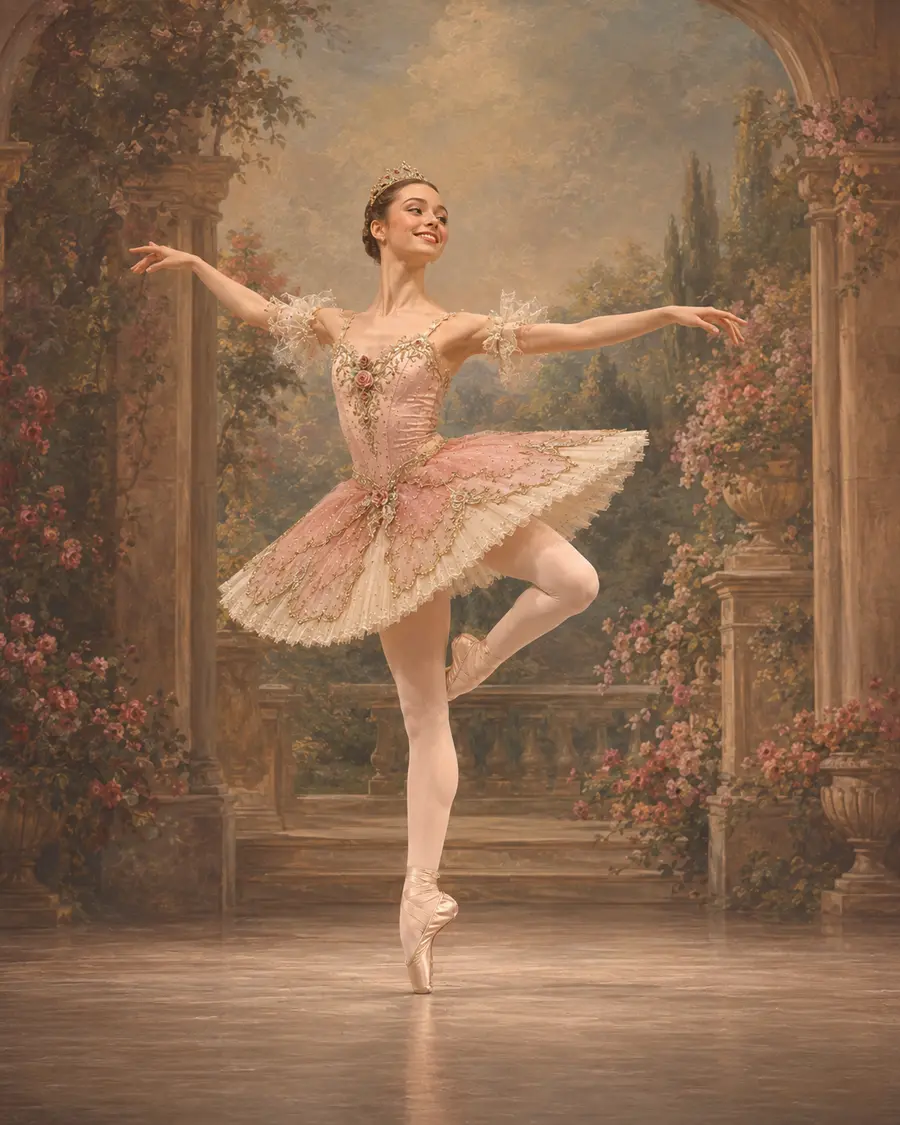
Aurora dancing at her sixteenth-birthday celebration in The Sleeping Beauty

Princess Aurora · Act I

Watch from curtain to curtain

Follow the promise from christening to wedding.

Watch the supplied production once for the full story, then return to compare the distinct Prologue fairy gifts, Aurora's growth, the Vision Scene, and the many classical styles gathered in the Act III divertissement.

User-supplied full productionPrologue and three-act ballet · playback is hosted by YouTube.

Open on YouTube ↗

The complete story

A promise carried across one hundred years.

Each act changes the scale of the same promise: the Lilac Fairy protects Aurora's future, Désiré chooses that future, and the wedding restores the court through music, ceremony, and classical dance.

01

Prologue

A christening, six gifts, and a curse

King Florestan and his Queen celebrate the christening of Princess Aurora. The invited fairies offer gifts that will shape the child: purity, grace, generosity, song, spirit, and wisdom. Their variations introduce the ballet's courtly world one distinct musical character at a time.

Carabosse arrives furious at being excluded and curses Aurora to die after pricking her finger. The Lilac Fairy cannot erase the curse, but transforms death into a century-long sleep that will end when a prince awakens the princess.

02

Act I

Aurora comes of age beneath the shadow of the spindle

On Aurora's sixteenth birthday, the palace welcomes four royal suitors. Aurora's entrance and the Rose Adagio reveal a princess meeting her kingdom with radiance, balance, and confidence while the court still fears Carabosse's prophecy.

A disguised Carabosse offers Aurora a spindle. The princess pricks her finger and collapses, but the Lilac Fairy keeps her promise: Aurora and the entire court fall asleep while a protective forest grows around the palace.

03

Act II

A vision leads Prince Désiré to the sleeping court

One hundred years later, Prince Désiré leaves a hunting party dissatisfied with courtly amusement. The Lilac Fairy shows him a vision of Aurora, whose dreamlike adagio and variations draw him toward the hidden kingdom.

Guided through the enchanted forest, Désiré reaches the palace and awakens Aurora. The sleeping court returns to life, and the prince asks for Aurora's hand in marriage.

04

Act III

A royal wedding becomes a celebration of classical style

Aurora and Désiré's wedding gathers the Lilac Fairy, jewel fairies, and characters from other Perrault tales. Silver, Diamond, Bluebird, and Princess Florine each bring a different texture to the grand divertissement.

The final grand pas de deux joins Aurora's poised classicism with Désiré's noble virtuosity. Their marriage completes the Lilac Fairy's promise and restores harmony to the kingdom.
Meet the characters

Fairy magic is shaped by courtly choices.

The story becomes clearer when the dancing is grounded in each character's intention—from Carabosse's wounded pride to the Lilac Fairy's patient wisdom.

01

The sleeping beauty

Princess Aurora

A princess whose journey moves from youthful openness to dreamlike lyricism and mature classical authority. Her balances and musical clarity must always serve the story.

02

The destined prince

Prince Désiré

A nobleman searching for purpose beyond courtly entertainment. His dancing combines clean classical line, elevation, and a calm sense of devotion.

03

Guardian of wisdom

The Lilac Fairy

The ballet's guiding force. She answers Carabosse with composure rather than anger and carries the story safely from the christening to the wedding.

04

The uninvited fairy

Carabosse

A formidable dramatic and mime role whose curse drives the action. Carabosse's theatrical scale gives the Lilac Fairy's restraint its power.

05

Aurora's parents

King Florestan and the Queen

The royal parents frame Aurora's childhood and coming of age. Their fear of the prophecy makes the birthday celebration both brilliant and fragile.

06

Master of ceremonies

Catalabutte

The court official blamed for omitting Carabosse from the guest list. His precise mime helps establish the etiquette, comedy, and danger of the Prologue.

For variation students

Know which celebration your variation belongs to.

The Prologue fairies present gifts, Aurora's Act I solo introduces a young princess, and the Act III variations celebrate a kingdom restored. That dramatic difference should be visible before the first technical step.

Find the Sleeping Beauty variations
  1. 01

    Fairy of the Crystal Fountain · Prologue

    Keep the balances, clear foot articulation, and port de bras transparent. This fairy's gift should read as purity rather than stiffness.

  2. 02

    Fairy of the Enchanted Garden · Prologue

    Also known as Coulante Fairy or the Fairy of Flowing Flour. Let the traveling steps and soft arms flow without losing clean pointe articulation.

  3. 03

    Fairy of the Woodland Glade · Prologue

    Shape the falling musical details with buoyant footwork and gentle épaulement, keeping the character warm and light.

  4. 04

    Canary Fairy · Prologue

    Quick footwork and sparkling head-and-arm accents should suggest birdsong while remaining fully classical rather than comic.

  5. 05

    Fairy of Temperament · Prologue

    Also called the Violente, Finger, or Golden Vine Fairy. Make every accented gesture decisive without hardening the shoulders or expression.

  6. 06

    Lilac Fairy · Prologue

    Sustained placement and unhurried authority establish the character who protects Aurora and guides the entire ballet.

  7. 07

    Aurora · Act I

    Youthful radiance must survive the exposed balances, changing directions, and stamina demands. Technique should look like spontaneous joy.

  8. 08

    Aurora · Act II

    Keep the Vision Scene weightless and dreamlike: sustained balances, soft pointe articulation, and continuous port de bras should feel like an apparition rather than a display.

  9. 09

    Prince Désiré Variation · Act III

    Connect elevation, turns, and noble épaulement into one generous phrase. The virtuosity belongs to the wedding, not a detached gala solo.

  10. 10

    Lilac Fairy · Act III

    Preserve the Lilac Fairy's calm authority while allowing the wedding divertissement to bring greater radiance and breadth.

  11. 11

    Silver Fairy · Act III

    Give the quick, glittering footwork a polished metallic clarity without making the upper body brittle.

  12. 12

    Diamond Fairy · Act III

    Balance brilliance with regal control so the variation reads as faceted and luminous rather than simply fast.

  13. 13

    Bluebird · Male · Act III

    Precise batterie, buoyant jumps, and a lifted torso create the illusion of flight while every landing remains quiet and controlled.

  14. 14

    Princess Florine · Act III

    Coordinate delicate pointe work and expansive phrasing with Bluebird's airborne quality, keeping the fairy-tale character refined.

Behind the ballet

A defining collaboration between Petipa and Tchaikovsky.

The Sleeping Beauty, Op. 66, was created for the Imperial Ballet and premiered at the Mariinsky Theatre in St. Petersburg in 1890. Marius Petipa's detailed choreographic plan and Tchaikovsky's symphonic score built a ballet in which mime, character, and pure classical dancing share one dramatic architecture.

Modern productions may alter musical cuts, fairy names, mime, and the order of individual wedding divertissements. The Prologue, Aurora's birthday, the Vision Scene, and the final wedding nevertheless preserve the ballet's essential path from prophecy to fulfillment.

American Ballet Theatre synopsis ↗Tchaikovsky Research work history ↗New York City Ballet repertory context ↗